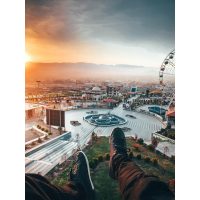
When most people imagine Dubai, they picture glass towers, luxury hotels, modern highways, and an ever-changing skyline.
Travel east from the city, however, and the landscape begins telling a much older story.
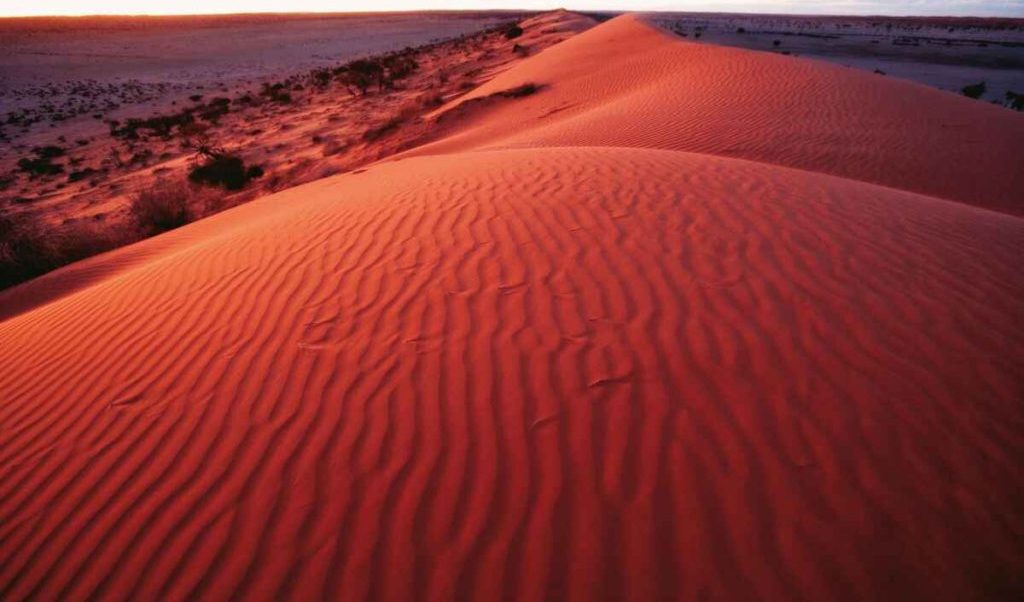
Buildings gradually disappear. Roads cut through increasingly open terrain, and pale sand begins giving way to deeper shades of orange, copper, and red. This is the landscape commonly associated with the Dubai Red Desert — one of the most visually distinctive parts of the emirate’s desert environment.
Today, these dunes are famous for desert adventures, photography, dune driving, quad biking, and safari experiences. But their story began long before Dubai became a global city.
The red dunes are the result of geological processes, changing climates, wind movement, mineral weathering, and thousands of years of human interaction with the Arabian landscape.
Understanding that history makes a visit to the desert considerably more meaningful.
Where Is Dubai’s Red Desert?
The best-known red dune landscapes are found inland from Dubai, particularly toward the eastern and southeastern parts of the emirate.
Lahbab is especially associated with the dramatic red-orange dunes travelers see in desert safari photography.
As you travel inland from Dubai’s coastal areas, the appearance of the sand changes noticeably.
Closer to the Arabian Gulf, sands contain a larger proportion of pale carbonate material associated with the marine environment. Farther inland, quartz-rich sands become increasingly important, and many dune fields develop stronger yellow, orange, brown, and red tones.
This geographical transition is part of what makes the desert around Dubai surprisingly diverse.
Not every Dubai desert landscape looks the same.
Why Is the Dubai Desert Red?
The red color has a geological explanation.
Research on the geology of the UAE describes inland desert sands as largely quartz-rich, with reddish colors resulting from trace iron that has oxidized into iron oxides such as hematite. In simple terms, tiny amounts of iron associated with the sand undergo oxidation — a process chemically related to the formation of rust.
Those iron-rich coatings give individual grains their warm coloration.
Over an enormous landscape, billions upon billions of similarly colored grains create dunes ranging from orange and copper to deep reddish brown.
Older geological descriptions of the UAE likewise note that red-brown desert sands are connected to oxidizing conditions in the arid environment.
Sunlight then changes how strongly those colors appear.
Under intense midday light, a dune can appear relatively pale. Early in the morning or near sunset, the same sand may appear significantly deeper red because shadows emphasize its texture and the lower-angle sunlight enhances the warm tones.
This is one reason the Dubai Red Desert can look remarkably different depending on when you visit.
The Story of the Sand Began Far Beyond Dubai
A sand dune may appear permanent, but desert sand is constantly being transported, sorted, and reshaped.
Geological research indicates that much of the interior sand of the UAE was transported from the northwest and derived from erosion of rocks in western and central Arabia. Wind subsequently helped redistribute the particles across enormous areas.
This means a grain of sand sitting on a Dubai dune today can be understood as part of a much larger geological system.
Rock is weathered.
Particles are released.
Wind transports them.
Minerals oxidize.
Dunes form, move, erode, and reform.
What visitors see as a beautiful red landscape is therefore the visible result of processes operating over immense periods of time.
The Arabian Desert Was Not Always as Dry as It Is Today
Perhaps the most fascinating part of the Red Desert story is that Arabia has not always experienced today’s extremely arid climate.
Scientific research into southeastern Arabian deserts shows that the region repeatedly shifted between more humid and more arid environmental conditions. These changes affected dunes, river systems, sediment movement, vegetation, and human settlement.
Some present-day desert landscapes preserve traces of environments dramatically different from what exists today.
There were periods when parts of Arabia received considerably more rainfall, supporting lakes, river systems, vegetation, and wildlife.
As climatic conditions changed, aridity increased again.
Wind became one of the landscape’s dominant forces.
Loose sediment was transported and reorganized into the dune fields that characterize large areas of Arabia today.
The desert, therefore, should not be thought of as something that appeared suddenly.
It is a landscape shaped by repeated environmental transformation.
The Red Dunes Are Still Moving
The Dubai Red Desert is ancient, but its surface is never truly finished.
Wind continuously moves individual sand grains.
Look carefully at an undisturbed dune and you will often see tiny parallel ripples running across its surface. These patterns may last only until the wind changes direction.
The dune itself is also slowly changing.
Sand is blown up one side, carried across the crest, and deposited on the opposite slope.
Over time, this causes dunes to migrate and change shape.
That means the desert landscape experienced today is not exactly the same landscape people encountered centuries ago.
The location may be the same, but individual dune ridges, slopes, and patterns are continuously being rewritten.
Before Modern Dubai, the Desert Was Part of Everyday Life
Long before the modern city expanded, desert environments were part of the economic and social geography of the region.
Communities across Arabia developed extensive knowledge of desert travel, seasonal conditions, water sources, livestock, navigation, and survival.
Camels became especially important because of their ability to travel long distances in arid environments.
The desert connected settlements rather than simply separating them.
Routes across inland Arabia supported movement between communities and facilitated trade, seasonal migration, and communication.
While modern travelers often enter the desert for recreation, earlier inhabitants approached the landscape as part of ordinary life.
For them, understanding the environment was not optional.
It was essential.
Archaeology Shows That Dubai’s Desert Has a Deep Human History
Modern archaeological research has also challenged the idea that desert regions were simply empty spaces between settlements.
The Dubai Desert Survey identified archaeological sites showing significant human occupation in desert areas during ancient periods.
Research at sites including Al-Ashoosh and Saruq al-Hadid demonstrated that people occupied or used parts of Dubai’s desert landscape thousands of years ago, including periods after climatic conditions became substantially drier.
This evidence adds another dimension to the history of Dubai’s desert.
The dunes and plains were not merely natural landscapes.
They formed part of environments through which people traveled, settled, worked, exchanged goods, and adapted to changing conditions.
Modern Dubai may be young compared with many ancient cities, but the landscape surrounding it contains a much deeper human timeline.
From Survival Landscape to Adventure Destination
The relationship between people and Dubai’s desert changed dramatically during the twentieth and twenty-first centuries.
Vehicles replaced camels as the principal means of transportation across many desert areas.
Road networks transformed movement.
Dubai expanded rapidly.
At the same time, the desert acquired a new role.
Instead of being primarily a place people needed to cross, it became somewhere visitors deliberately traveled to experience.
The modern Desert safari Dubai industry grew around this transformation.
Four-wheel-drive vehicles made it possible for travelers with no desert-driving experience to explore deep dune terrain with experienced drivers.
Activities such as dune bashing, sandboarding, camel riding, desert camping, and photography turned the desert itself into one of Dubai’s major visitor experiences.
Yet the underlying landscape remains far older than the tourism industry surrounding it.
Why the Red Desert Became Especially Popular for Safaris
Dubai has several desert areas, but red dune landscapes are particularly appealing because of their combination of color, scale, and visual contrast.
Against a clear blue sky, the red-orange dunes create one of the most recognizable desert scenes in the UAE.
Higher dune formations can also provide varied terrain for off-road activities.
This helps explain why red desert locations have become strongly associated with adventure-oriented safari experiences.
Visitors searching for a Desert safari Dubai increasingly encounter experiences designed around these deeper-colored inland landscapes rather than simply the closest available patch of desert.
For photographers, the difference can be even more noticeable.
Warm sand, blue sky, dark vehicle silhouettes, and changing shadows create naturally strong visual compositions.
Morning Dune Bashing Shows Another Side of the Red Desert
Although sunset receives much of the attention, early morning offers one of the most interesting times to experience red dunes.
During Morning dune bashing, shadows can stretch across dune ridges and reveal details in the landscape that become harder to distinguish once the sun rises higher.
The cooler part of the day can also create a calmer atmosphere before many later safari groups enter popular areas.
As a four-wheel-drive vehicle crosses a dune, it becomes possible to see the terrain from multiple elevations.
From the bottom, a dune can appear like a wall of sand.
From the crest, the landscape suddenly opens into multiple ridges extending toward the horizon.
This changing perspective helps visitors appreciate that a desert is not a flat, empty space.
It is a constantly changing terrain.
Quad Biking Creates a More Direct Connection With the Landscape
Dune bashing allows passengers to experience the terrain from inside a four-wheel-drive vehicle.
Quad biking creates a very different relationship with it.
During a Desert safari with quad bike, riders experience changes in the surface more directly.
Soft sand requires different handling from compacted tracks.
Small ridges, inclines, and depressions become much more noticeable when you are controlling the vehicle yourself.
The experience can make travelers much more aware of the physical structure of the desert.
What looked like a smooth dune from a distance suddenly reveals countless variations in texture and elevation.
For this reason, quad biking has become one of the activities most strongly associated with adventure-focused red desert excursions.
The Color of the Desert Changes Throughout the Day
One of the most remarkable characteristics of Dubai’s red desert is that its appearance is never completely fixed.
At sunrise, the dunes can display muted orange and pink tones.
As sunlight strengthens, they may appear brighter and more golden.
Late afternoon gradually restores deeper orange tones.
Close to sunset, some slopes can appear dark copper or reddish brown while neighboring ridges remain bright.
None of this means the sand itself has suddenly changed composition.
Instead, the angle and intensity of light alter how we perceive the mineral-rich surface.
For photographers, this makes timing extremely important.
The same location photographed several hours apart can look like two completely different deserts.
Wind Is the Desert’s Architect
Dubai’s skyscrapers are designed by architects.
Its dunes are designed by wind.
Wind determines where loose sand accumulates and where it is removed.
Different wind directions and strengths create different dune structures.
A strong gust may erase footprints within minutes.
Repeated wind patterns can gradually build enormous ridges.
Even the delicate rippled texture visible on a dune’s surface is created by the movement and sorting of individual grains.
The result is a landscape that appears sculpted despite having no permanent sculptor.
Every dune represents a temporary balance between wind, gravity, sand supply, and terrain.
Desert Life Is More Resilient Than It Appears
To someone visiting for the first time, the red desert can appear almost lifeless.
That impression is misleading.
Arabian desert environments support plants and animals adapted to extreme conditions.
Vegetation may remain sparse because water is limited, but certain species can survive intense heat, long dry periods, and nutrient-poor soils.
Wildlife similarly relies on behavioral and biological adaptations to survive.
Some animals avoid daytime heat.
Others obtain much of the moisture they require through their food.
For visitors, this is another reason to treat desert environments responsibly.
What appears to be an empty area of sand may actually be habitat.
The Red Desert and Modern Dubai Tell Two Parts of the Same Story
Dubai’s skyline is often used as evidence of how dramatically the emirate has changed.
The desert provides the counterpoint.
Standing among the dunes, a visitor can see a landscape shaped on geological timescales rather than construction schedules.
One represents rapid human transformation.
The other represents gradual natural transformation.
Experiencing both helps provide a more complete understanding of Dubai.
The city demonstrates what has changed.
The desert helps reveal what was here before it.
Experiencing the Red Desert Responsibly
As desert tourism expands, responsible use becomes increasingly important.
Visitors can help protect the environment by avoiding litter, respecting wildlife, following designated activity areas, and listening to experienced guides.
Operators also play an important role through responsible driving practices and camp management.
Deserts can look incredibly resilient because wind quickly removes visible tracks.
But ecological disturbance can last much longer than footprints.
A memorable safari should therefore combine adventure with respect for the landscape.
From Ancient Sand to Modern Desert Safari Dubai
Perhaps the most interesting thing about the Dubai Red Desert is the contrast between its timescales.
The geological processes behind the dunes developed over immense periods.
Human communities interacted with Arabian desert environments for thousands of years.
Modern Dubai then transformed extraordinarily quickly.
Today, a traveler can leave a contemporary city filled with skyscrapers and within a relatively short journey find themselves surrounded by a landscape governed primarily by sand, wind, sunlight, and gravity.
That transition is part of what makes a Desert safari Dubai experience distinctive.
The attraction is not simply dune bashing or taking photographs.
It is the opportunity to enter a landscape whose story began long before the city visible on the horizon.
Final Thoughts
Dubai’s red desert deserves to be understood as more than an adventure playground.
Its color reflects the mineral composition and oxidation of inland sands. Its dunes preserve evidence of long-term climatic and geological processes. Archaeological discoveries show that human activity in Dubai’s desert stretches back thousands of years.
Today, visitors experience the same broad landscape through entirely different activities.
Some arrive for Morning dune bashing.
Others choose a Desert safari with quad bike.
Many simply want to stand on a dune as the sun begins to disappear and watch the sand change from orange to deep red.
Behind every one of those experiences, however, is a landscape with a history far greater than a single safari.
The next time you see Dubai’s red dunes, look beyond their color.
You are looking at geology, climate, human history, and modern Dubai meeting in the same place.